
Use the words you already have.
You don’t need to know the name of the solution yet. Start with the problem as you would describe it to someone else.
My Grasshopper script is super slow. I think the point search is causing the issue.
From there, we’ve got a few directions to look at. But the main one here is the point search.
So search that in Scripository and see what we have.
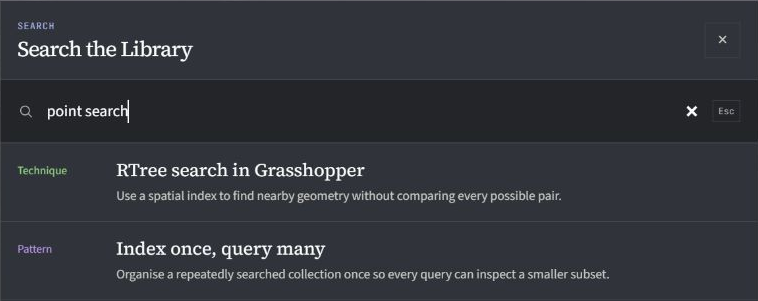
The closest match is RTree search in Grasshopper. It’s a Technique you can open and copy straight into your script.
But it also links out to a bigger picture. It’s connected to the Principle Reduce the search space, which applies to almost every script.
What are you working with?
A point search uses points to represent locations. But your project might start with curves or other geometry. Understanding what those points represent helps you decide whether their proximity answers your actual question.
Concepts explain how geometry, data, or a computational idea behaves. Follow a link to one when you need that understanding, then return to the resource you were using. You can enter the Library wherever your problem takes you.
Reduce the search space
When a script has a lot of things to check, the obvious approach is to check all of them.Reduce the search space asks a different question: what can be ruled out before the expensive or precise work begins?
In this point search, comparing every query point with every source point will work. But most of those points were never close enough to matter.
An RTree applies this Principle by organising the source points so that each search begins with a much smaller set of nearby candidates. The exact distance check only runs on that set.
This is what a Principle is useful for. It doesn’t tell you which component or tool to use. It gives you a way to think about the problem that you can carry into other scripts.
That kind of point search turns up in lots of different scripts. The points may change, and so may the reason for searching them, but you keep running into the same kind of problem. That is where a Pattern becomes useful.
Read the Principle: Reduce the search spaceWhat structure can you reuse?
The Pattern Index once, query many gives that recurring problem a reusable arrangement. Organise a stable source collection once, then ask the index for a bounded candidate set each time another object needs to search it.
Read a Pattern when you recognise the class of problem but still need to understand how a durable solution is arranged. The same Pattern may have several tool-specific implementations.
Read the Pattern: Index once, query manyHow do you implement it in your tool?
The Technique RTree search in Grasshopper makes the Pattern concrete. It names the inputs, outputs, dependencies, limits, and implementation choices for Rhino and Grasshopper.
Read a Technique when you are ready to build. Its public preview should tell you what it does and whether it fits before the complete implementation asks for account or paid access.
The explanation of the approach and its fit is open. Complete implementation material follows the Technique’s access state.
The definition is an included file. It sits inside the Technique because the Technique provides the explanation, limits, and maintenance context needed to use it.
Open the Technique: RTree search in GrasshopperWhen does this become a Workflow?
A Workflow is useful when the outcome depends on several Techniques and human decisions repeated in sequence—for example, preparing project data, running spatial searches, checking exceptions, and reviewing the result before issue.
- 01Prepare
- 02Query
- 03Verify
- 04Review
The nearby-point example does not need a separate Workflow merely to complete the set. Its useful path ends at one Technique and its included file. Look for a Workflow only when your real outcome spans a larger repeatable process.
For the next problem
Use the questions again.
- 01
What outcome am I trying to reach? Search in the language of the problem, tool, or project condition.
- 02
What do I need to understand? Follow a link to a Concept when the geometry, data, or idea needs explaining.
- 03
What should I keep in mind? Open a Principle for a way of thinking you can carry into the problem.
- 04
What structure can I reuse? Open a Pattern when you need the arrangement before the implementation.
- 05
How does it work in my context? Open a Technique for a tool-specific method and its included files.
- 06
Does the outcome span several methods and decisions? Look for a Workflow that connects them.